
A room-by-room approach to technology that remains understandable, resilient and discreet.
Write the experience before choosing devices
Start with sentences about daily life: the hall is softly lit at night; blinds reduce afternoon heat; guests can operate a bedroom without an app. These outcomes are more durable than a shopping list. Rank them by value and complexity, then automate only where the benefit is clear.
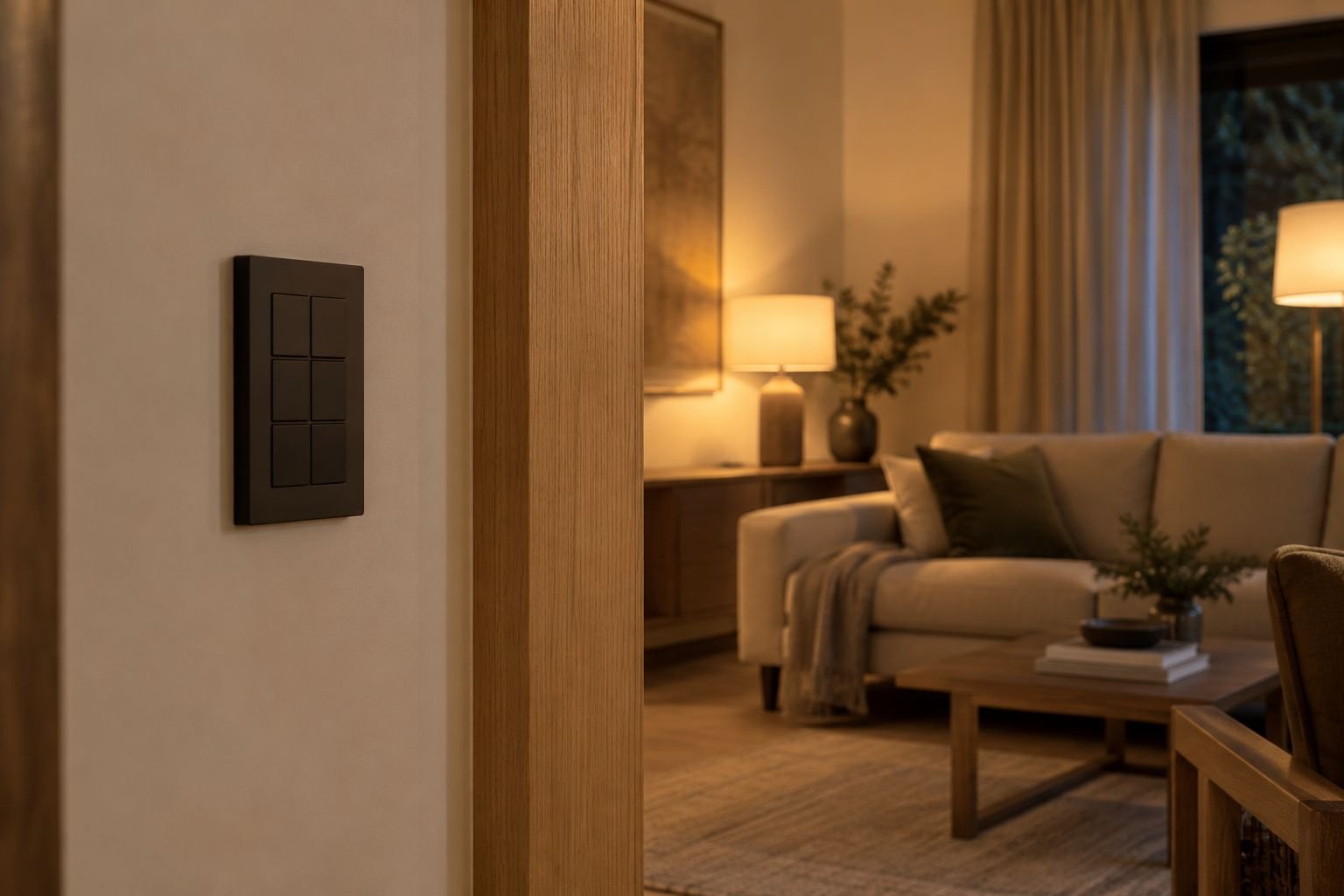
A calm home always retains obvious manual control. A wall switch should work when a phone is flat, a guest is present or an internet service is unavailable. Automation can add convenience, but it should not make basic tasks mysterious.
Build a reliable network foundation
Lighting, climate, security and media depend on the home network. Plan wired data, wireless access points, equipment ventilation and power backup with the architecture. Hide equipment in an accessible, cooled location rather than sealing it behind joinery. Label cables and document every port.
Separate critical systems from casual gadgets where appropriate, use unique credentials and keep firmware supported. Cybersecurity is an ongoing household responsibility, not a feature purchased once. Ask integrators who can administer the system, where data is stored and how access is revoked.
Use interoperability as risk reduction
Matter is an application-layer standard developed by the Connectivity Standards Alliance to improve interoperability across smart-home ecosystems. Compatible, certified devices can reduce dependence on a single interface, but the logo does not guarantee that every advanced feature appears identically in every platform.
Choose the primary ecosystem deliberately, then verify each desired function in that environment. Keep a record of device model, location, account and reset process. Standards evolve; a maintainable installation depends as much on documentation and network quality as on protocol labels.
Design lighting in layers
Automated lighting is most convincing when the underlying lighting design is good. Combine ambient, task and accent light, use appropriate color temperature and avoid excessive downlights. Scenes should correspond to real activities—arrival, cooking, dining, reading and night circulation—rather than theatrical names nobody remembers.
Place keypads where people expect controls and limit the number of buttons. Engraving or clear labels help guests. Motion sensing is useful in service spaces and at night, but poorly timed sensors quickly become irritating. Always provide an easy override.
Protect privacy and resilience
Cameras and microphones require explicit household decisions about location, retention and access. Avoid surveillance in private interior spaces and explain devices to guests and staff. Prefer local processing where it meets the need, while recognizing that backups and remote access can still involve cloud services.
Plan for outages. Doors must open, water can be shut off, heating remains safe and lighting can be controlled without a remote server. Test these conditions during commissioning instead of discovering them during a failure.
Create an exit strategy
Technology ages faster than architecture. Install conduits, accessible power and replaceable modules. Avoid embedding short-lived tablets permanently into crafted surfaces. Keep finishes independent from device dimensions so replacements do not require rebuilding a room.
A final handover should include diagrams, passwords transferred securely, warranties, settings and a yearly review. The best smart home recedes from attention. It makes the house easier to inhabit today and leaves a clear path for change tomorrow.
Commission with real people
Test the house with a person who did not help design it. Ask them to enter after dark, find the bathroom, adjust a bedroom and turn everything off without instruction. Their hesitation reveals where labels, switch positions or scenes are too clever. Repeat the exercise with the internet disconnected and with a primary controller unavailable.
Create a one-page household guide for ordinary tasks and a detailed technical record for maintenance. The first should explain lighting, climate, blinds and guest access in plain language. The second should list equipment, network details, warranties, installers and reset procedures, with credentials stored securely. Update both whenever a device changes. Schedule a seasonal review after occupants have lived with the system; remove automations that annoy them and simplify controls that attract repeated questions.
Create a hierarchy of control
Decide which actions must remain local, which may be automated and which can use remote access. Door locks, water shutoff and climate protection need reliable local operation. Convenience scenes and entertainment can tolerate more complexity. This hierarchy guides network segmentation, backup power and the amount of integration justified for each system.
Give every room a predictable primary control. Consistent button order and language reduce learning, particularly for guests and household staff. Avoid placing essential functions only inside a touchscreen menu. If a custom interface is used, keep the route to lights, temperature and shades short and visible.
Notifications should be exceptional and actionable. A home that reports every door movement or minor temperature change trains occupants to ignore it. Define who receives water, security, equipment and access alerts, what action is expected and how the warning is cleared.
Procure for support, not novelty
Ask how long the manufacturer commits to security updates, whether local functions survive an account outage and how data can be exported or deleted. A device that depends on an unsupported cloud service can become electronic waste while the surrounding room remains new.
Prefer equipment that a competent local professional can maintain. Proprietary systems can be appropriate when the installer relationship, documentation and long-term support are strong, but ownership should include administrator access and a practical transition plan. Avoid dependence on one individual’s undocumented knowledge.
Keep spare capacity in conduits, network ports and electrical panels. Technology changes are easier when the physical infrastructure is generous. This invisible flexibility is often more valuable than installing every available feature at completion.
Review privacy with the household
List devices that sense presence, sound, video, energy or access. For each, record purpose, data location, retention and authorized viewers. Remove collection that has no clear benefit. Household members and regular staff should know what operates in shared spaces and how to raise a concern.
A calm smart home is understandable even when its technology is sophisticated. People can predict what will happen, override it and recover from failure. That confidence, rather than the number of connected devices, is the lasting measure of success.
Know when the design is finished
A system is complete when ordinary tasks are obvious, failure modes are safe, documentation is current and the household no longer needs the installer for routine changes. Additional scenes and sensors should be added only when a repeated need is observed. Possibility alone is not a design requirement.
After the first year, remove abandoned automations and accounts, update credentials and confirm that backups and administrator access still work. A smaller system that the household understands is safer and more valuable than a feature-rich installation whose operation depends on memory or one unavailable technician. Record the review date and the person responsible for the next one so maintenance remains an explicit household task rather than an assumption.
Sources and further reading
Official and authoritative material used to support this guide. Access dates reflect editorial research.
- Matter Digital Media Kit, Connectivity Standards Alliance. Accessed October 12, 2026.